Choosing among Aluminum Beverage Cans is not simply a matter of appearance. Can diameter, height, volume, neck shape, and opening style all affect production, storage, transport, and customer experience. A tall 500-milliliter can feels different in the hand from a compact 250-milliliter can. That difference matters on a crowded retail shelf.
Robert Budway, president of the Can Manufacturers Institute, has stated, “The aluminum beverage can is the most recycled beverage package in the world.” His observation highlights a central advantage of these containers: aluminum can move through recycling systems repeatedly when collection and processing work effectively. Still, recycling performance is not automatic. Local infrastructure, contamination, and consumer habits can weaken the result.
This guide examines the main types available, including standard cans, slim cans, sleek cans, stubby formats, and custom-shaped designs. It also considers specialized features, such as resealable lids, different can ends, colored finishes, and printed surfaces. Each option creates practical trade-offs. A slimmer body may support a premium image, but it can require careful filling-line adjustments. A larger can may provide better value for some beverages, yet increase shipping weight and shelf-space demands.
The details can be easy to overlook. They should not be. Beverage makers must match the can to carbonation, filling speed, product volume, branding goals, and regional recycling conditions. Some assumptions will fail in practice. That is worth remembering. A strong choice is not always the most unusual one; it is the format that performs reliably from filling plant to consumer’s hand.
Aluminum Beverage Can Basics: 3104 and 3004 Alloys in Modern Production
Aluminum beverage cans rely on carefully selected alloys, not one universal grade. The 3004 alloy contains manganese and magnesium, giving it useful strength, corrosion resistance, and formability. It has supported drawn-and-ironed can production for decades. Modern plants increasingly use 3104 alloy for can bodies. Its higher strength allows thinner walls while maintaining pressure resistance during filling, stacking, and transport. The difference seems small. It affects material efficiency.
Can ends usually require a stronger alloy system than the body. Manufacturers must balance easy forming with reliable opening performance.
According to the Aluminum Association’s 2023 industry data, beverage cans in North America contained about 73% recycled aluminum on average. The International Aluminium Institute reports that recycling aluminum uses roughly 95% less energy than producing primary metal.
These figures support alloy recovery, but they need careful reading. Regional collection rates, recycled-content definitions, and reporting years can vary. The 3004-to-3104 transition is not equally visible in every production line. Some plants still select 3004 for specific forming behavior or supply conditions. Real production is more complicated than a simple “stronger is better” claim.
Standard Can Sizes: Comparing 250 mL, 330 mL, 355 mL, and 473 mL Formats
Aluminum beverage cans are available in several familiar formats, but volume is only part of the decision. The 250 mL can suits controlled portions, sampling, and premium serving occasions. Its smaller footprint also fits narrow shelves and compact vending equipment. The 330 mL format remains a practical international reference. It balances portability, fill volume, and efficient pallet use.
The 355 mL can equals the common 12-fluid-ounce format used in North America. It gives consumers more liquid without a major increase in diameter. The 473 mL can, often called a pint format, supports longer drinking occasions and larger servings. However, its taller body may need stronger stacking control. Can height, end diameter, wall strength, and internal pressure all affect line performance. Volume alone does not tell the full packaging story.
The Can Manufacturers Institute reported strong demand for aluminum beverage cans in its 2024 industry updates. The Aluminum Association also reports that an average aluminum can contains about 73% recycled material. These figures support aluminum’s established role in circular packaging systems. Still, recycled content varies by region and supply conditions. The boundaries are not perfectly universal. A 330 mL can may outperform a 355 mL can in one market, while the reverse may apply elsewhere. Packaging teams should test filling speed, cooling time, transport damage, and consumer handling before choosing a standard size. A neat size comparison can become misleading.
What Types of Aluminum Beverage Cans Are Available? - Standard Can Sizes: Comparing 250 mL, 330 mL, 355 mL, and 473 mL Formats
| Can Format |
Metric Capacity |
Approx. U.S. Fluid Ounces |
Typical External Dimensions
(Diameter × Height) |
Typical Empty-Can Weight |
Common Beverage Applications |
Key Advantages |
| 250 mL Compact |
250 mL |
8.45 fl oz |
Approximately 66 mm × 92 mm
(2.60 in × 3.62 in) |
Approximately 10–13 g |
Energy drinks, soft drinks, mixers, flavored water, and small-portion beverages |
Portable serving size, lower product volume per unit, and convenient for portion control |
| 330 mL Standard |
330 mL |
11.16 fl oz |
Approximately 66 mm × 115 mm
(2.60 in × 4.53 in) |
Approximately 12–15 g |
Carbonated soft drinks, sparkling water, beer, cider, juice-based drinks, and functional beverages |
Widely used international serving size with a balanced height-to-volume ratio |
| 355 mL Standard |
355 mL |
12.00 fl oz |
Approximately 66 mm × 122 mm
(2.60 in × 4.80 in) |
Approximately 13–16 g |
Soft drinks, beer, sparkling beverages, iced tea, coffee drinks, and sports beverages |
Common 12-fluid-ounce format with strong compatibility across filling, packaging, and retail systems |
| 473 mL Tall |
473 mL |
16.00 fl oz |
Approximately 66 mm × 157 mm
(2.60 in × 6.18 in) |
Approximately 16–20 g |
Energy drinks, craft beverages, beer, cold coffee, sports drinks, and larger servings of soft drinks |
Higher volume per container, strong shelf presence, and suitable for active or on-the-go consumption |
Dimensions and empty-can weights are typical industry ranges for common aluminum beverage-can formats. Actual specifications may vary according to the can manufacturer, body design, wall thickness, end type, filling requirements, and applicable packaging standards. Aluminum beverage cans are generally recyclable where local collection and processing infrastructure is available.
Slim, Sleek, and Standard Cans: How 202–211 mm Diameters Shape Use
What Types of Aluminum Beverage Cans Are Available?
Aluminum beverage cans usually fall into slim, sleek, and standard formats. The codes 202, 204, and 211 are industry size references, not literal millimetre diameters. They commonly describe can-end dimensions based on sixteenths of an inch. Actual diameters are much smaller, usually around 52 to 68 millimetres.
Slim cans feel narrow and tall in the hand. Their smaller diameter suits sparkling water, energy drinks, and portion-controlled beverages. They also fit neatly into car holders and compact refrigerator shelves. Sleek cans offer a slightly wider body while keeping a refined, elongated profile. This shape gives more room for front-panel graphics without feeling bulky. In my experience, the difference is noticeable during filling, stacking, and hand use.
Standard cans, often associated with the 211 size, provide a familiar grip and stable footprint. Their broader body can support stronger shelf presence and efficient pallet packing. Diameter also affects the opening area, label layout, cooling speed, and perceived serving size. A narrow can may chill quickly, but it can feel less stable on a table. That trade-off deserves testing. Packaging teams should confirm the supplier’s drawings, end compatibility, seam measurements, and production line settings. Size codes can vary in casual discussions, and that creates avoidable mistakes. Physical samples remain essential.
What Types of Aluminum Beverage Cans Are Available?
Slim, Sleek, and Standard Cans: How 202–211 End-Size Codes Shape Use
Aluminum beverage-can end-size codes are traditionally expressed in sixteenths of an inch. Under this convention, 202, 204, 206, and 211 correspond to nominal end diameters of approximately 57.2, 60.3, 63.5, and 68.3 mm. Smaller formats generally support slim, lightweight packages, while larger diameters provide more opening area and are commonly suited to standard or higher-volume cans. Finished can dimensions vary with necking, tooling, and regional specifications.
Specialty Aluminum Cans: Sleek, Stubby, Resealable, and Shaped Designs
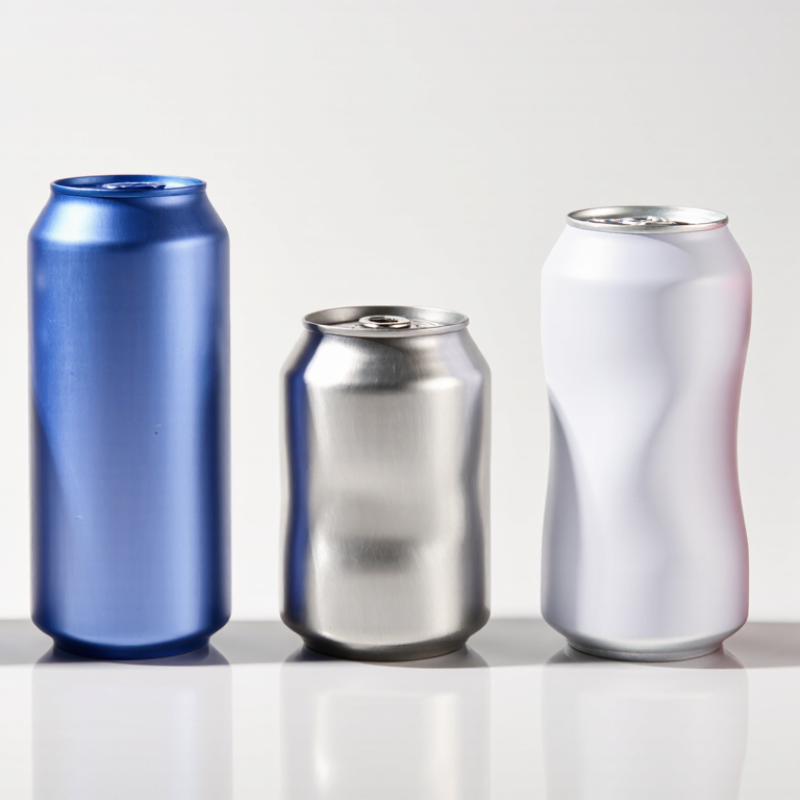
Specialty aluminum beverage cans extend beyond the familiar tall, straight format. Sleek cans use a narrow profile and smooth shoulder, helping premium drinks feel lighter in the hand. Stubby cans are shorter and wider, with a stable base and a strong visual block on crowded shelves. Shaped cans can add curves, tapered panels, or embossed details. These features improve recognition, but they may complicate filling, labeling, and stacking. Not every attractive shape performs well in distribution.
Resealable cans use a closure that can open and close repeatedly. This suits beverages consumed slowly, especially during travel or outdoor activities. The closure must balance convenience with seal strength, pressure control, and pouring comfort. A poor design may leak after only a few openings. That detail matters.
Beverage packaging engineers typically test drop resistance, internal pressure, seam integrity, and thermal cycling before approval. According to the International Aluminium Institute, recycled aluminum production uses roughly 5% of the energy required for primary aluminum production. The Aluminum Association has reported that recycled content in North American beverage cans is about 70%, although figures vary by year and measurement method.
Format selection should match the drink, filling line, and customer habit. A 250-milliliter stubby can may feel controlled, while a taller sleek can supports a longer drinking occasion. Shaped designs can create strong shelf presence, yet they often require more specialized tooling. Industry lifecycle assessments also warn that transport efficiency can change when dimensions move away from standard can geometry.
The imperfect truth is simple: distinctive packaging attracts attention, but practical performance still decides repeat use.
Can Performance Data: 12–15 g Weights, Pressure Resistance, and Recyclability
What Types of Aluminum Beverage Cans Are Available?
Can Performance Data: 12–15 g Weights, Pressure Resistance, and Recyclability
Aluminum beverage cans come in standard, slim, sleek, and larger formats. Their shape affects filling speed, cooling time, and shelf presentation. Lightweight can bodies may weigh about 12–15 grams, depending on volume and wall design. This range is not universal. A 330-milliliter can and a 500-milliliter can cannot be judged by weight alone. Alloy composition, diameter, and manufacturing tolerances also matter.
Pressure resistance deserves closer attention. Carbonated drinks create internal pressure, especially after storage in warm conditions. A reliable can uses a shaped dome, reinforced rim, and carefully formed ends. Factory testing may include pressure, leakage, buckle, and drop checks. In practical inspections, the rim should feel even, while the base should not rock on a flat table. Small defects can become serious during transport. Pressure data should always match the exact can size and filling condition.
Recyclability is a major advantage of aluminum packaging. Used cans can return to the production cycle when collection and sorting systems work properly. Clean, separated material usually supports better recovery. However, recycling rates vary between regions, and not every discarded can is recovered. That detail is easy to overlook. A lighter can can reduce material use, but excessive weight reduction may affect handling or resistance. The best choice balances 12–15 gram targets with verified performance data, not attractive numbers alone.
Conclusion
Aluminum Beverage Cans are widely used for drinks because they combine low weight, strength, and excellent recyclability. Modern production commonly relies on 3104 and 3004 aluminum alloys, which provide the balance of formability and durability needed for drawing, shaping, and filling. Standard capacities include 250 mL, 330 mL, 355 mL, and 473 mL, allowing manufacturers to match package size with serving preferences and market needs.
Can dimensions also influence appearance, handling, and storage. Slim, sleek, and standard formats typically use diameters ranging from approximately 202 to 211 mm, while specialty options include stubby, resealable, and shaped designs. Many cans weigh about 12–15 grams, yet their structure can withstand internal pressure during filling, transportation, and storage. After use, aluminum can be efficiently recovered and recycled, supporting a circular packaging system and reducing the need for new raw materials.

